
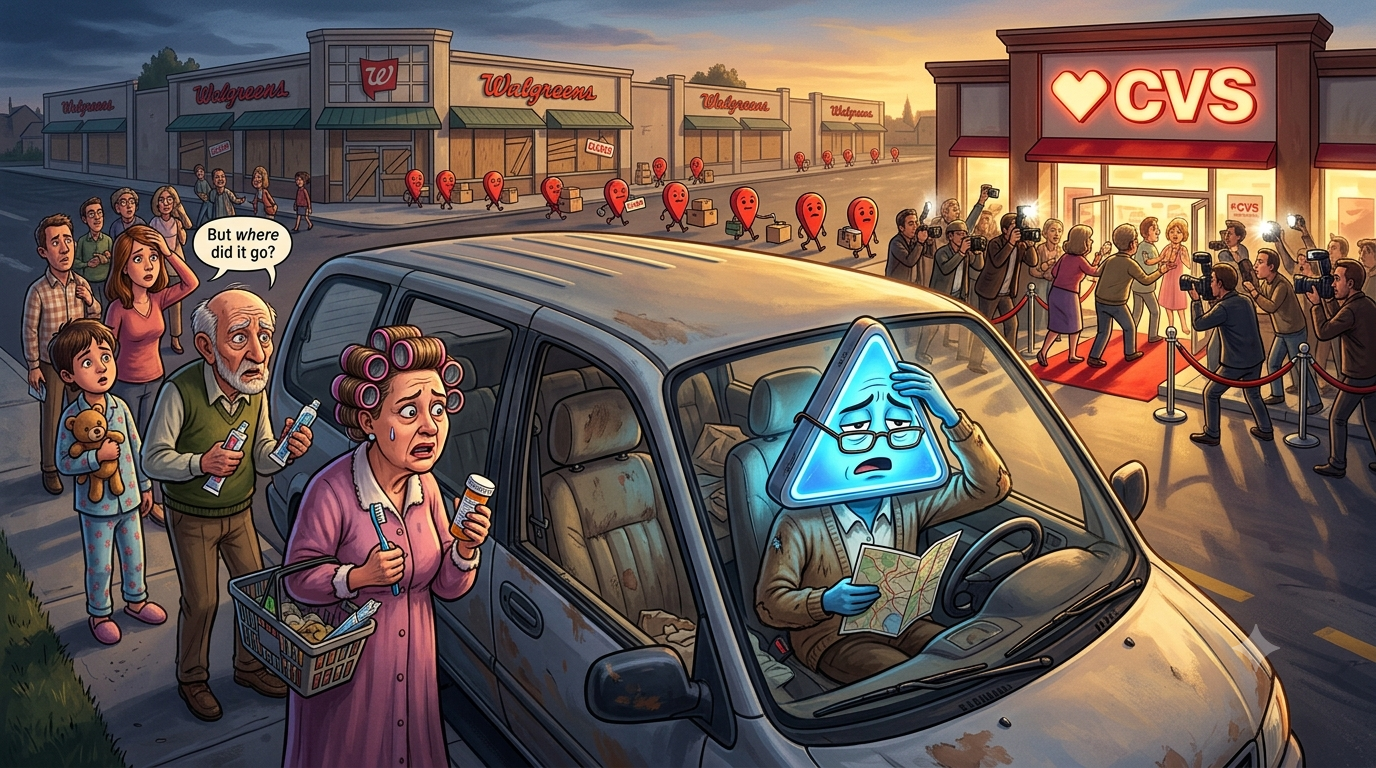

For years, Americans believed they chose their neighborhood Walgreens. This week, Walgreens gently reminded everyone that the relationship was never equal.
The pharmacy chain announced another round of store closures as part of its long-running “store optimization strategy.” In reality, millions of people have now discovered that the nearest Walgreens wasn’t simply convenient—it had silently become part of their daily routine, like ignoring low-battery warnings or pretending they’ll only buy one item.
The closures themselves aren’t the funniest part.
The funniest part is watching perfectly rational adults stare at a map saying, “Wait… where do I buy toothpaste now?” as if civilization ended between aisle seven and the greeting cards.
GPS companies reportedly experienced an emotional spike in searches for “nearest pharmacy.” One fictional spokesperson admitted, “Our navigation system hasn’t comforted this many people since everyone forgot where they parked at Costco.”
Retail analysts say Walgreens is concentrating on higher-performing locations. Ordinary people hear something different:
“So… my Walgreens wasn’t one of the popular kids.”
Entire neighborhoods have begun speaking about former stores the way people discuss childhood diners.
“Oh, that’s where the Walgreens used to be.”
Nobody remembers what medicine they bought there.
Everyone remembers where the seasonal candy display was.
Meanwhile, nearby CVS locations are experiencing what experts describe as “unexpected celebrity syndrome.” Employees who spent years being politely ignored are suddenly giving directions like museum guides.
“Yes,” one obviously fictional cashier said, “this is now the closest pharmacy. Please remain calm while adjusting your emotional expectations.”
An equally fictional study from the Institute for Extremely Specific Consumer Habits found that 83% of customers could identify the exact location of the self-checkout machine from memory, yet couldn’t remember their cousin’s birthday without Facebook.
Even corporate buzzwords have become strangely personal.
“Footprint optimization” sounds efficient until you realize it mostly means your actual feet now have farther to walk.
The irony is that Walgreens still operates thousands of locations. The chain isn’t disappearing.
It’s simply teaching Americans an uncomfortable lesson:
A building isn’t important until the day your navigation app quietly stops suggesting it.
And somewhere, a GPS voice has learned to say, “I’m sorry for your inconvenience” with genuine emotional depth.
Internet Reactions
@MapLover92:
“I’ve apparently been emotionally dependent on a pharmacy.”
@CorporateTranslator:
“‘Store optimization’ is business for ‘good luck, everybody.'”
@CVSIntern:
“This is the biggest promotion I’ve never received.”
@LostAgain:
“My GPS asked if I was okay today.”
@ParkingLotHistorian:
“We don’t lose stores. We lose landmarks.”
Screenshot Quote
“The saddest part of a store closure isn’t the building—it’s realizing your GPS knew your routine better than your friends.”