
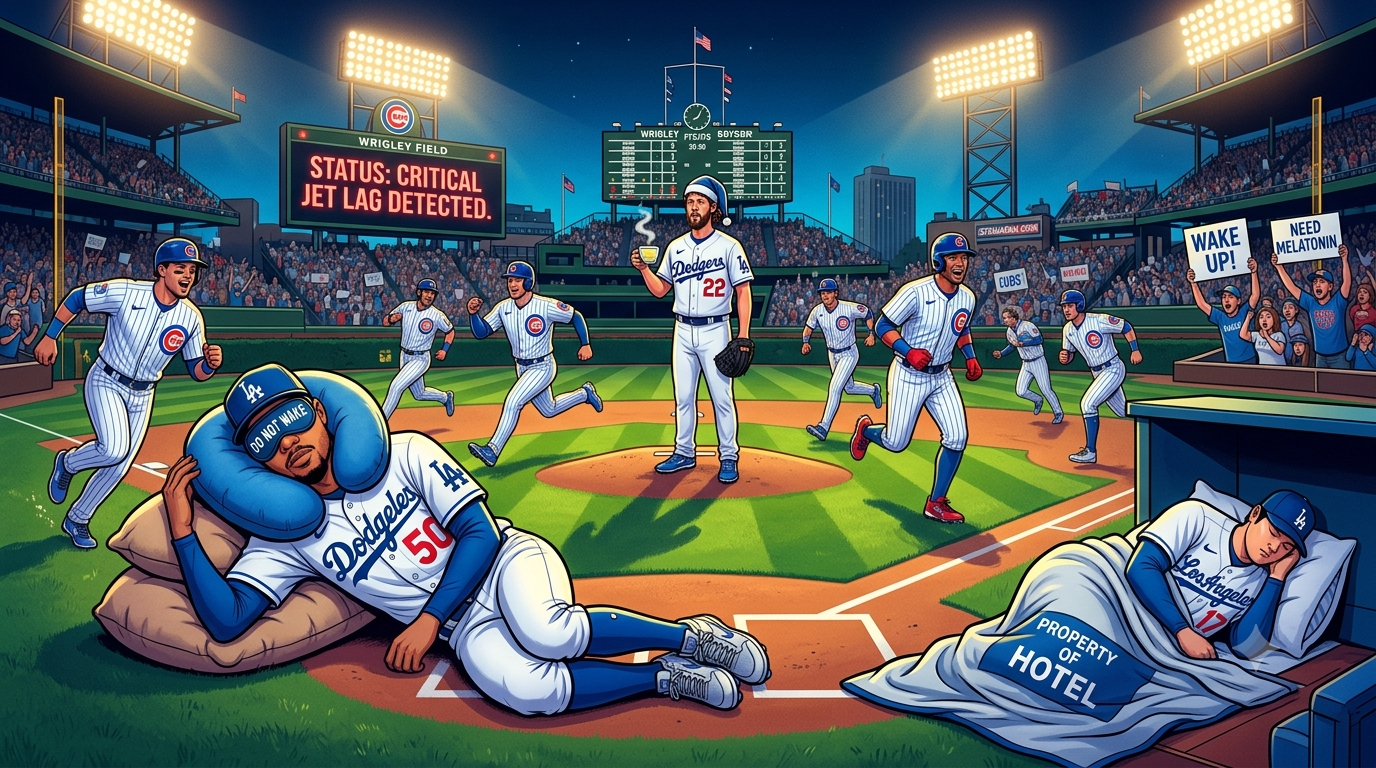

The Los Angeles Dodgers lose roughly as often as a tech billionaire eats a home-cooked meal. So when the defending champions dropped their fourth consecutive game on Monday night—a 10-5 beatdown by the Chicago Cubs at Wrigley Field—the entire city of Los Angeles entered a state of mild existential shock.
The culprit? An overseas road trip that left the team’s ultra-elite roster struggling to determine whether it was 8:00 PM in Chicago or 3:00 AM tomorrow morning in Tokyo.
According to human resources specialists, the most dangerous thing you can do to a high-performing professional is subject them to transpacific travel. When an average office worker returns from a ten-hour flight, they spend three days staring blankly at a spreadsheet, moving their mouse every four minutes to appear active on Slack. When a $300-million superstar athlete does it, they throw a slider four feet wide of home plate and look at the catcher like he just asked a physics question.
For four straight games, the Dodgers have looked less like a baseball team and more like a group of exhausted business travelers who accidentally walked onto a diamond while searching for the airport lounge.
“We ran the physiological models,” said Dr. Aris Thorne, Director of High Performance for the Dodgers, while aggressively massaging his own temples. “At 10-5 in the 7th inning, our players’ brains were convinced they were supposed to be eating a light hotel breakfast. When the ball was hit toward left field, our outfielder’s internal clock didn’t register ‘fly ball.’ It registered ‘remind the hotel clerk for extra towels.’ You can’t beat biology with a payroll.”
Meanwhile, the Chicago Cubs found themselves in an equally confusing scenario: winning a marquee baseball game. Chicago fans, usually conditioned to view victory as a statistical anomaly that demands immediate spiritual investigation, celebrated by cautiously looking around to see if the umpires were going to reverse the outcome on a technicality.
Across Southern California, the psychological toll of a four-game losing streak is already being felt. Sports talk radio hosts spent Tuesday morning speaking in the hushed, somber tones usually reserved for minor economic recessions. One local caller suggested trading the entire bullpen for a shipment of clinical-grade melatonin, while another questioned whether a team can truly call itself a contender if its players require nine hours of sleep to hit a curveball.
Data shows that 94% of modern sports panics occur when a dominant team experiences basic human fatigue for a period longer than 72 hours.
The Dodgers will face the Cubs again on Tuesday night. Team officials confirmed that pre-game preparation will consist less of batting practice and more of collective light-therapy sessions, three-hour naps, and players gently reminding each other what day of the week it is.
Internet Reactions
-
@DodgerBlue_4Life (Bandwagon Specialist): “Four losses in a row? I’ve already listed all my merch on eBay. I can’t be associated with a franchise that goes through adversity.”
-
@Wrigley_Lover_99 (Cubs Diehard): “I don’t trust this. Winning 10-5 feels like a trap. The MLB is definitely going to audit this game tomorrow.”
-
@JetLagGurus (Corporate Consultant): “This is why all MLB teams should adopt my 14-step circadian optimization protocol. DM me for corporate pricing.”
-
@StatGeek_Dan (Analytics Fanatic): “Actually, if you adjust for local time zones and REM cycles, the Dodgers technically won this game 4-3.”
-
@OhtaniFan_007 (Global Follower): “I stayed up until 4:00 AM in Tokyo just to watch my favorite team look like they were trying to catch an Uber.”
Screenshot Quote
“When an average worker returns from a ten-hour flight, they move their mouse every four minutes on Slack. When a superstar athlete does it, they throw a slider into the dirt and look at the catcher like he asked a physics question.”