


When two premium ice cream brands dress identically for the grocery shelf party, the federal court system steps in to enforce a $23.8 million outfit change.
There is a precise moment of existential dread that occurs every night at 9:15 PM in the frozen aisle of American grocery stores. A shopper stands shivering before a glass freezer door, staring at forty-eight identical monochromatic paper cylinders, entirely incapable of deciphering whether they are holding an organic oat-milk lavender brew from Williamsburg or a $7 zero-sugar butter pecan made for midwestern ketosis.
That confusion is officially worth $23.785 million.
Rebel Creamery, the low-carb ice cream maker sold across Walmart, Kroger, and Safeway nationwide, has filed for Chapter 11 bankruptcy in Utah. The move comes directly on the heels of a federal court ruling ordering Rebel to hand over nearly $24 million in profits to rival Van Leeuwen Ice Cream for copying their packaging. According to the court, Rebel intentionally infringed on Van Leeuwen’s “trade dress”—a legally protected aesthetic ecosystem consisting of a single solid pastel color, a matching lid, black cursive font, and an overarching vibe that whispers “this pint costs more than your lunch.”
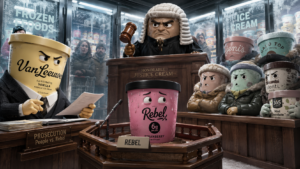
“The evidence left no doubt that Rebel infringed and diluted Van Leeuwen’s trade dress,” wrote U.S. District Judge Eric Komitee, delivering a devastating blow to the low-carb community’s favorite aesthetic.
The core issue isn’t cream content or sugar substitutes—it’s that modern grocery stores have devolved into a visual sea of minimalist pastel containers designed to make processed dairy look like high-end French skincare. When every brand attempts to communicate “artisan purity” by stripping away all graphics, logos, and joy, they inevitably end up looking like identical props from a dystopian movie set.
During the trial, Van Leeuwen originally demanded $36.4 million of Rebel’s profits. However, the court generously knocked 33% off the fine after recognizing a fundamental biological truth: a significant portion of Rebel’s customers weren’t tricked by the chic packaging—they were simply desperately seeking a pint of ice cream that wouldn’t ruin their ketosis.
“We felt a 33% discount reflected the proportion of buyers who bought the product for its nutritional profile rather than its striking resemblance to a millennial apartment accent wall,” noted court filings implicitly.
Rebel enters bankruptcy court listing $13.78 million in assets against $23.85 million in liabilities—meaning Van Leeuwen’s legal claim accounts for approximately 99.7% of Rebel’s fixed unsecured debt. To survive, Rebel must now undergo a mandatory court-ordered redesign, forcing brand managers to answer the ultimate graphic design dilemma: how do you market a premium grocery product in 2026 without using a solid pastel color and a script font?
Meanwhile, grocery store shoppers across the country remain stranded in front of the freezer, carefully inspecting Helvetica kerning on pastel tubs just to make sure they aren’t accidentally financing a corporate legal settlement.
Internet Reactions
@KetoKen99: “Great, now I have to check my ice cream’s legal filings before I check its net carb count.”
@DesignGirl_NYC: “Honestly, if your brand identity is just ‘a color and a cursive font,’ maybe the court should award $23M to the concept of minimalism itself.”
@GroceryLurker: “I spent 10 minutes yesterday staring at 6 identical sage green tubs. One was ice cream, one was plant-based lotion, and one was modern spackle.”
@CorporateSnark: “Filing Chapter 11 because your ice cream looked too much like a competitor’s pastel dream board is peak modern capitalism.”
@LateNightSnacker: “I don’t care about trade dress, I just want to know if this $9 pint is going to make me poop or kick me out of ketosis.”

